


















Migero glaciers, a winter tale!
Author Discover Crete
News
News

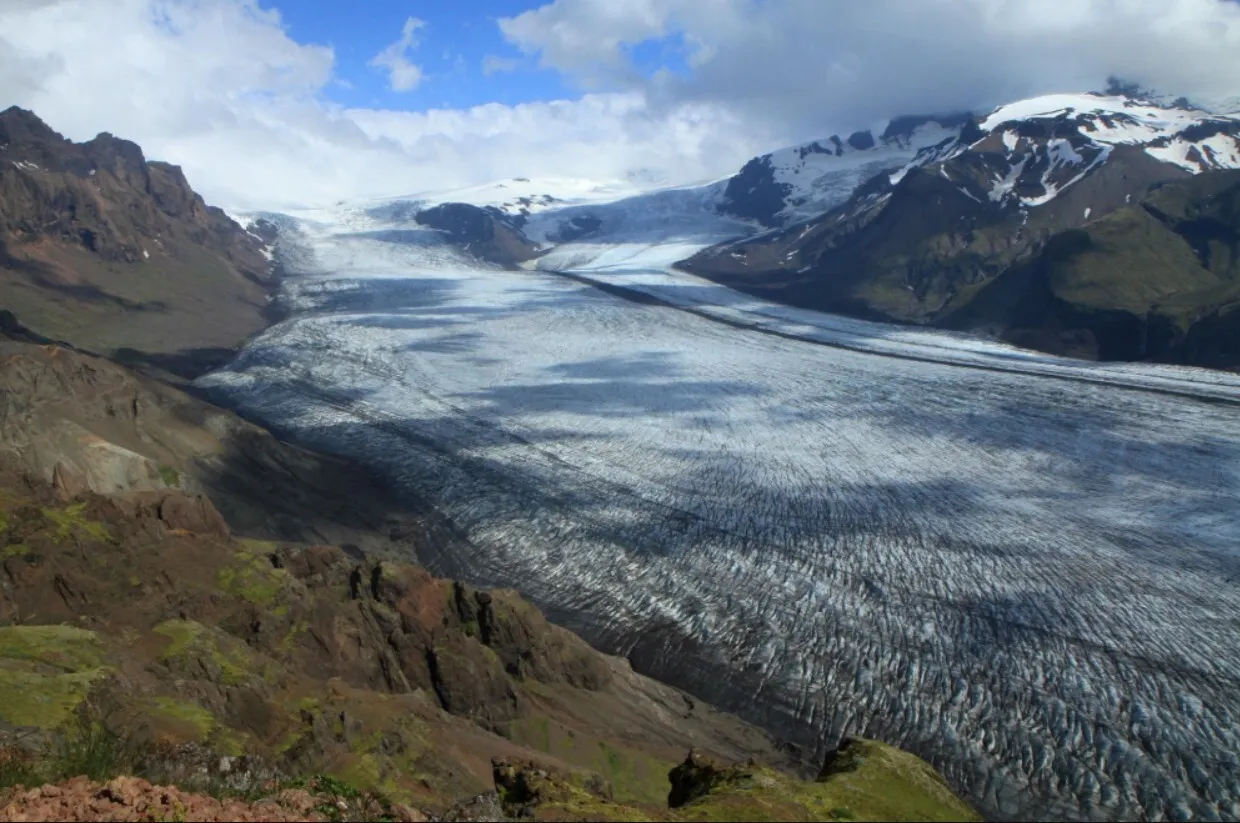
When a large volume of snow/ice accumulates in one place for a long period of time, it forms thick masses called glaciers. Today, glaciers exist in various parts of the Earth (e.g., at the poles, at high altitudes), but during past glacial periods, they developed in more places.
Glacial periods are long periods of colder climate, alternating with warmer interglacial periods.
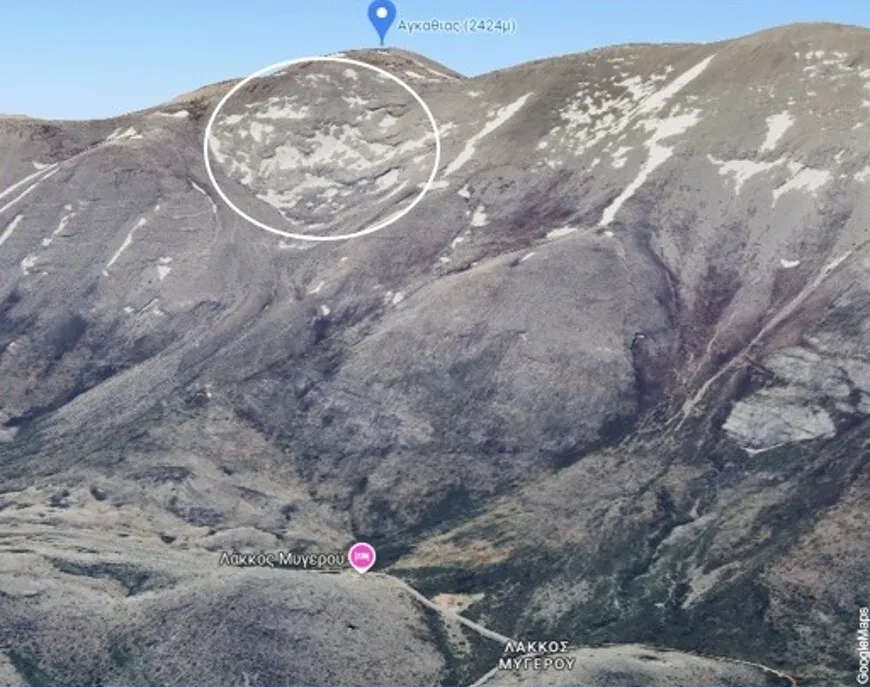
Because of its own weight and gravity, a glacier flows like a “river of ice”, sculpting mountain landscapes as it moves downslope! Looking from Migero Plateau towards the top of Agathias, there is a “polished” concave surface, called a cirque, forming an amphitheater-like shape on the mountain (white frame). There, the snow concentrated and the formation of the glacier was taking place…
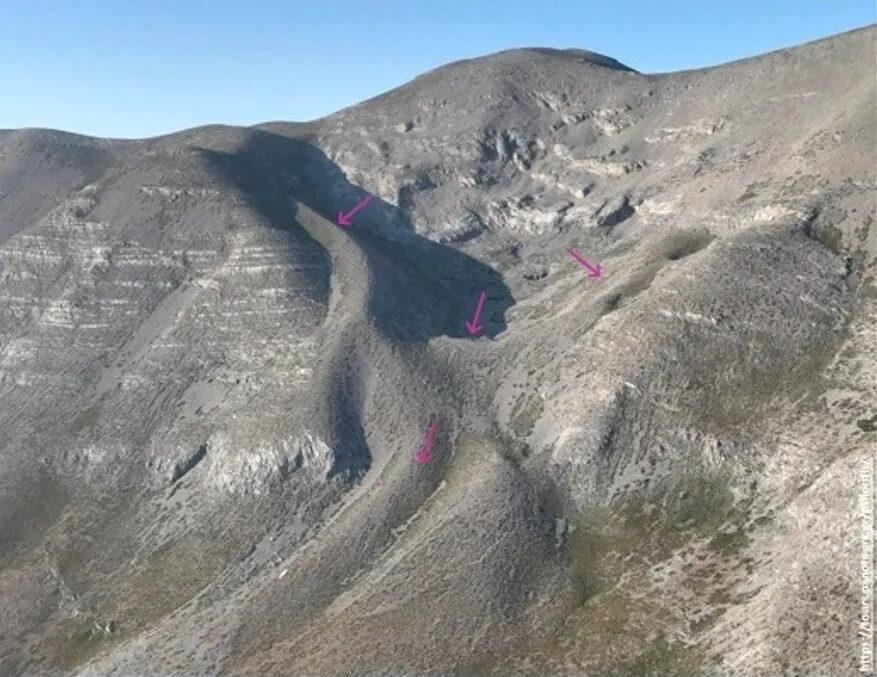
Through its course, the glacier removes and carries along pieces of rock. From materials deposited due to the down-slope movement of the glacier, a “tongue” of debris appears, forming a “ridge” at each terminal point (pink arrows), called a moraine. The cirque-moraine system of Migero has been sculpted by glaciers hundreds of thousands of years ago!
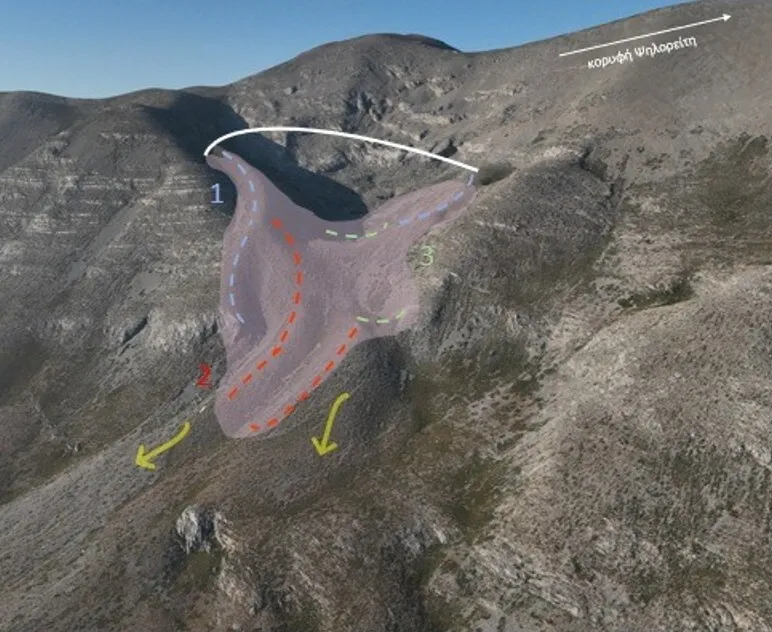
At first, it appears that there was a larger and wider glacier, that defined the formation of the lateral moraines (Unit 1 – blue dashed lines). The younger phase of Unit 2 followed (red dashed lines), which extends downwards in a form that looks like a “tongue”. This formation was shaped by the melting of the glacier, where the debris rolling downhill “opened” like a fan (yellow arrows).
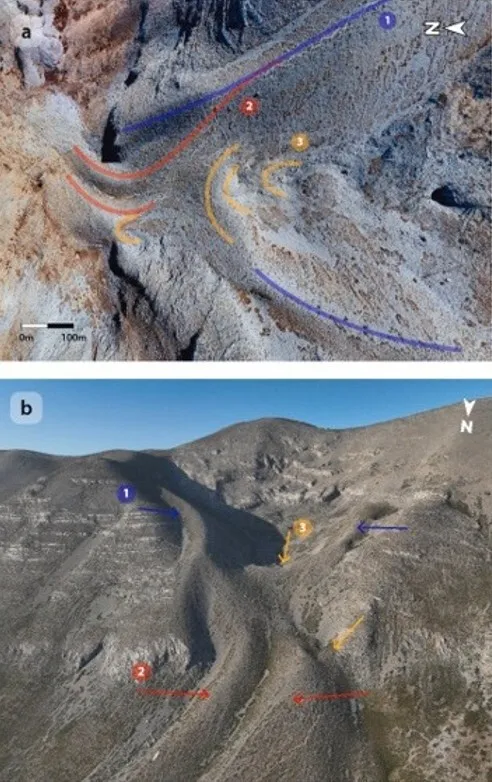
Although Units 1 & 2 are distinct (Unit 2 was formed after Unit 1), it is not certain that they were formed during different glacial periods. That is, it is possible that they were formed during different glacial phases of the same glacial period, sometime during the Middle Pleistocene, 478-424 to 190-120 thousand years ago.
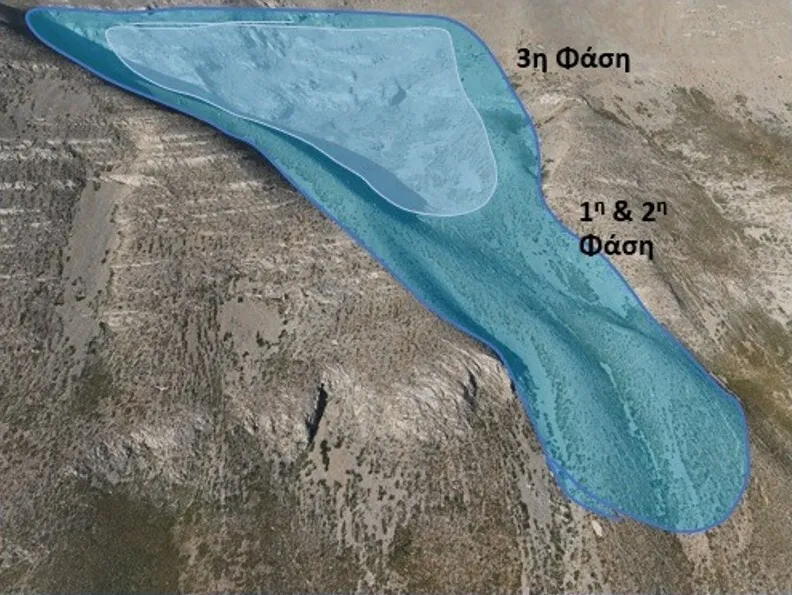
Much later, above the deposits of the older Units 1 & 2, Unit 3 was deposited as a terminal moraine. The characteristics of Unit 3 and their similarity to other Late Pleistocene glacial deposits from mainland Greece, seem to place it during the “Last Glacial Maximum”, approximately between 29,000 and 19,000 years ago! Above this moraine, the hiking path zig-zags towards the summit!
Why don’t we have similar traces of past glaciers in other parts of Psiloritis or Crete?
What probably was in favor of the formation of glaciers in Migero was a combination of different factors such as the location and the geomorphology of the area, the paleo-climatic conditions of that time and the geological history of Psiloritis in comparison to the rest of the mountains of the island!
For more information, you can see the scientific paper on the Quaternary glaciers of Crete, here: https://www.sciencedirect.com/...
To explore the highest peaks of Psiloritis virtually (also available through a Virtual Reality device), click here: https://psiloritisgeopark.gr/e...
Photos: Aris Leontaritis – The Greek Mountain Project and Psiloritis Geopark



Related news