
















“In the Middle of the World: Crete in European Cartography from the 16th to the 18th Century. Representations and Identities”
Author Discover Crete
Culture
Culture

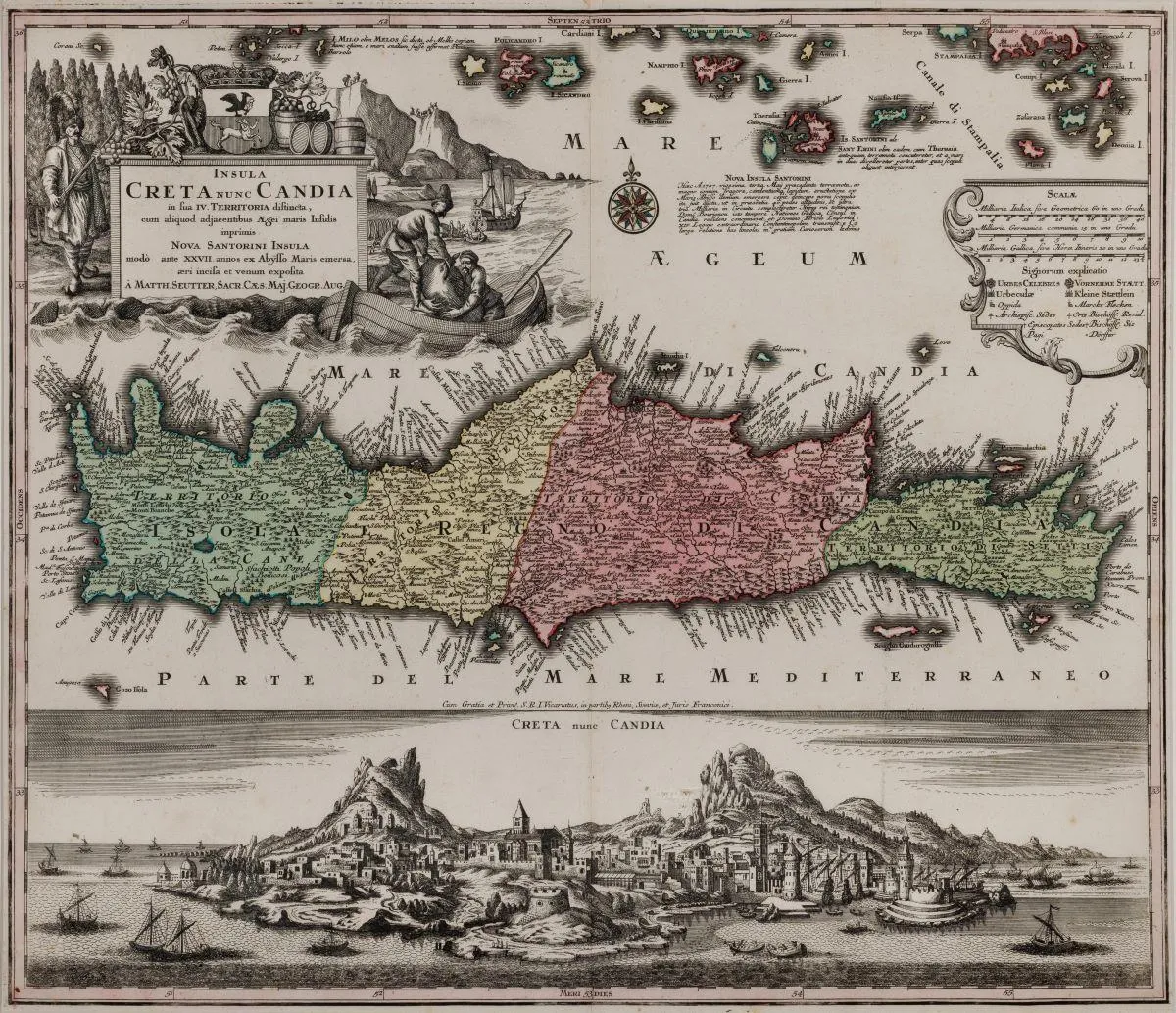
The temporary exhibitions of the Heraklion Archaeological Museum offer new ways of seeing the world from a different perspective. Their museological concept is not limited to presenting unknown or overlooked works of art of outstanding importance. They seek to leave behind a legacy of images, knowledge and questions that will remain with us for many years to come.
Crete in the historical cartography of the 16th to the 18th century is illustrated through fifty maps, each of which tells, in its own way, the story of the lives and deeds of its people. The exhibition is the result of a collaboration between the Heraklion Archaeological Museum and Kostis Christakis, archaeologist and curator of the British School at Athens at Knossos, and Nikos Skoutelis, professor at the School of Architecture of the Technical University of Crete.
It gives us the opportunity to encounter Crete under Venetian rule at the height of its prosperity, its pivotal importance at the crossroads of the maritime trade routes that made possible the historic dialogue between West and East, the Cretan War with the dramatic siege and final fall of Chandax, and finally the cartographic incorporation of the island into Greece, while it was already part of the victorious Ottoman Empire.
Through the dynamic relationship between cartographers and the world they were called upon to depict — from topography, the natural and man-made environment, the inhabitants, myths and the history of the island, to the universe itself — the artistic creation of maps emerged for more than three centuries as a field of scientific experimentation, lived experience, political propaganda, questioning of reality and utopian thought.
This encounter takes on particular symbolism as it is hosted at the Heraklion Archaeological Museum, whose building occupies the ancient rise of the city, the very place where the Venetian monastery of Agios Fragiskos was built — a landmark for ships arriving at the harbour from every route across the Mediterranean. It was also in this monastery, after its conversion into the Hünkâr Mosque, that the first prayer was held by the conqueror of the ruined Chandax after twenty-one years of fierce siege.
The exhibition explores this fascinating journey, brought to life through lectures, a round-table discussion, a film screening, a workshop and guided tours throughout its duration, from 29 September 2026 to 10 January 2027.
Venue: Heraklion Archaeological Museum, Temporary Exhibitions Hall
Temporary Exhibition: “In the Middle of the World: Crete in European Cartography from the 16th to the 18th Century. Representations and Identities”
Exhibition Opening: 29 September 2026, 18:30
Exhibition Duration: 29.09.2026 – 10.01.2027
Opening Hours: Heraklion Archaeological Museum opening hours
Admission: €5